How to pack for a move the right way can save you hours of stress, protect your belongings, and keep your moving costs under control. The truth is, when damages happen inside of a box, it’s typically due to packing mistakes and not the handling.
Proper packing is the most important part of ensuring your belongings get to your new home safely. At Purple Peacock Movers, when we do a local packing job, we have a rule. You should be able to drop the box and nothing inside breaks. With the proper packing techniques, this is possible.
Quick Answer — Here's How to Pack for a Move:
- Start early — at least 6 weeks out for a large home.
- Declutter first — donate, sell, or toss what you don't need. Check with the Houston Furniture Bank, Goodwill, or the Red Cross and they may offer free pick up for donated items.
- Gather supplies — boxes, packing tape, packing paper, bubble wrap, markers. We typically find that your local large U-Haul facilities or ½ Price Boxes stores have the best pricing. Storage facilities are normally the most expensive places to buy moving supplies.
- Pack room by room — start with storage and rarely used spaces, end with the kitchen.
- Label every box on the sides — include the destination room. If you want to go a step further, you can add the contents of each box, although we find this unnecessary. As long as you label the box for the intended room and identify if it’s fragile, then that is normally plenty to make unpacking easy and safe.
- Protect fragile items — wrap individually, use packing paper for padding, and make sure you don’t hear glass clinking together once packed.
- Pack an essentials box last — ideally you want to pack things that you don’t want lost, hold extreme sentimental value, or small high value items. I.E. checkbooks, fine jewelry, credit cards, prescriptions, etc.
Most people underestimate how long packing takes. A typical 3-bedroom home needs 60–80 boxes and takes roughly 30 hours for 1 person to pack. Packing the kitchen normally takes 1 person 4–6 hours on their own to pack. If you hire a local moving company to pack your belongings, they normally send multiple professional packers who will pack your entire home in a day.
The good news? With a clear plan, the whole process becomes much more manageable.
Planning Your Timeline: How to Pack for a Move Step-by-Step
Packing up your entire life is a psychological marathon. It is completely normal to feel a bit of packing paralysis. However, breaking the process down into a structured timeline is the ultimate cure for moving anxiety.
Let's look at how to map out your journey so you are not left wrapping coffee mugs in your pajamas at midnight the night before the truck arrives.
How Early Should You Start Packing?
The short answer is: earlier than you think! The average household underestimates the time needed to pack by over a week.
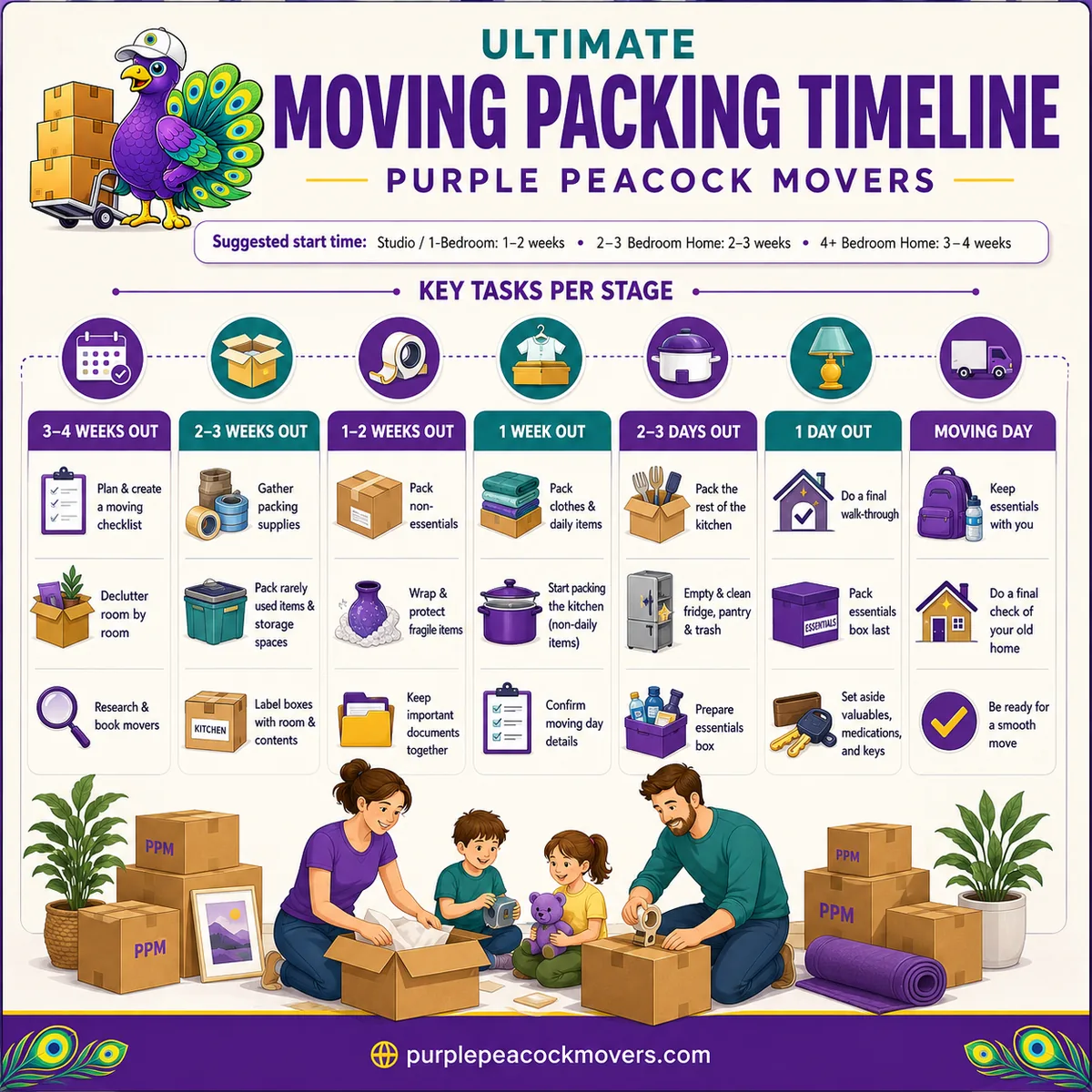
While a small studio or 1-bedroom apartment might only take 1 to 2 days of active packing (requiring 15 to 30 boxes), larger homes require a much longer runway. Here is a general timeline guide based on home size:
- Studio / 1-Bedroom Apartment: 1–2 weeks out
- 2–3 Bedroom Home: 2–3 weeks out
- 4+ Bedroom Home: 3–4 weeks out
If you try to compress this into a single weekend, you risk physical exhaustion, damaged items, and a disorganized pile of boxes at your new place. By starting early, you can pace yourself and ensure you have the time to be detailed and thoughtful about the boxes you pack.
The Recommended Room-by-Room Packing Order
To maintain your sanity, you must pack systematically. If you pack your everyday kitchen items first, you will find yourself eating takeout with your fingers for a month.
Instead, follow our recommended room-by-room packing order, starting with the spaces you use the least:
- Storage Areas: The attic, basement, garage, and spare closets. These areas are filled with seasonal items, holiday decorations, and outdoor gear that you will not miss.
- Guest Rooms & Formal Spaces: Spare bedrooms, formal dining rooms, and formal living areas.
- Home Decor & Books: Artwork, framed photos, trinkets, vases, and books. These are non-essential items that take a surprising amount of time to pack safely.
- Bedrooms: Pack away out-of-season clothing, extra linens, and shoes you do not wear daily.
- Bathrooms: Pack backup toiletries and guest towels, leaving only your daily essentials.
- The Kitchen: The kitchen is universally considered the most time-consuming and hardest room to pack. Save this for the final week, but do not leave it for the last day! Keep out a few plates, cups, and utensils, and box up the rest.
- The Essentials "Open First" Box: This is the very last box you pack and the first one you unload.
Decluttering, Supplies, and Box Organization
Before you tape up a single box, you need to make some executive decisions. Moving is the perfect opportunity to hit the reset button on your relationship with "stuff."
Ruthless Decluttering Strategies Before You Pack
Here is a golden rule worth remembering: you pay to move everything you do not throw away.
Customers who declutter before packing save significantly on moving costs, primarily from needing a smaller truck or fewer hours of labor. If you are hiring professional help, a lighter load translates directly to a lower bill.
To declutter ruthlessly, we recommend using the Four-Box Method. Go room by room and categorize every item into one of four piles:
- Keep: Items you love, use regularly, and have a clear place for in your new home.
- Donate/Sell: Gently used items that no longer serve you but still have life left in them.
- Trash/Recycle: Broken, worn-out, or expired items.
- Maybe: For items you are on the fence about, use Chase's Rule of Decluttering: if an item costs less than $20 to replace and you haven't used it in a year, let it go. Alternatively, pack these items into a "Maybe Box," seal it, and write a date 6 months in the future on the side. If you haven't opened it by that date, donate it completely unopened!
Evaluate each item and place it in one of the four boxes.
→2CATEGORIZEFour-box methodKEEPDONATE / SELLTRASH / RECYCLEMAYBE→3TAKE ACTIONDecide and actPack with confidence.Set aside to donate or sell.Dispose of responsibly.Pack in a “Maybe Box” and seal.→4FINAL CHECKLighten your loadReview your categories and ensure everything has a home.
Pack less. Move easier.
Essential Packing Supplies You Actually Need
Do not make the mistake of scrounging for weak, damp grocery store boxes. High-quality supplies are cheap insurance for your valuable belongings.
Before you start, gather these essentials:
- Cardboard Boxes: You will need a mix of small (1.5 cu ft), medium (3 cu ft), and large (4.5–6 cu ft) boxes.
- Heavy-Duty Packing Tape: Buy more than you think you need. A tape gun is a lifesaver.
- Unprinted Packing Paper: Avoid using printed newspaper, as the ink can transfer and permanently stain your porcelain, glass, and fine china.
- Bubble Wrap: Essential for highly fragile items if you are packing yourself.
- Permanent Markers: Buy a multi-pack (they have a habit of disappearing during a move!).
- Specialty Boxes: Wardrobe boxes, dish packs, and mattress bags.
If you want to skip the hassle of sourcing supplies and packing everything yourself, you can always look into professional Packing Services to handle the heavy lifting.
To help you budget, here is a comparison of standard cardboard boxes versus specialty moving containers:
| Box Type | Best Used For | Average Cost |
|---|---|---|
| Small Box (1.5 cu ft) | Books, tools, canned goods, heavy items | $1.50 – $2.00 |
| Medium Box (3.0 cu ft) | Toys, kitchen appliances, folded clothes | $2.50 – $3.50 |
| Large Box (4.5+ cu ft) | Pillows, blankets, comforters, lampshades | $3.50 – $4.50 |
| Dish Pack Box | Plates, glassware, stemware, bowls | $6.00 – $10.00 |
| Wardrobe Box | Hanging clothes (includes metal hanging bar) | $12.00 – $18.00 |
For a comprehensive checklist on how to structure your overall preparation, check out How to Pack for a Move: The Ultimate 12-Step Checklist (2026) - Moving Checklist.
Packing Hacks for Clothes, Fragile Items, and Electronics
Once your supplies are ready and your home is decluttered, it is time to master the mechanics of packing. Applying a few clever hacks can save you time, space, and money.
How to Pack for a Move: Clothing and Hanging Items
Packing clothes does not have to involve hours of folding and ironing.
The easiest way to pack hanging clothes is the garbage bag hack. Keep your clothes directly on their hangers. Group them in bundles of 10 to 15, tie the hanger hooks together with an elastic band or zip tie, and slide a heavy-duty contractor trash bag over the clothes from the bottom up, pulling the drawstring tight around the hanger hooks.
This creates a low-cost, instant wardrobe bag that keeps your clothes clean and ready to hang immediately in your new closet.
For your folded clothes, leave them right in your dresser drawers! If the dresser is sturdy, you can simply remove the drawers, wrap them in plastic wrap to keep the contents secure, and transport them as-is. Alternatively, pack heavy sweaters and shoes into rolling suitcases to make them easy to transport.
If you are facing a tight timeline and need to pack up your wardrobe and home quickly, refer to How to Pack for a Move in One Week: The Ultimate 7-Day Survival Guide (2026) - Moving Checklist for rapid-packing strategies.
Packing Fragile Items, Dishes, and Glassware
Dishes and glassware are highly susceptible to damage if packed incorrectly. To ensure they survive the journey, follow these steps:
- Use a Double-Walled Box: Always use heavy-duty dish packs for kitchenware.
- Pack Plates Vertically: Never stack plates flat on top of one another. Instead, wrap each plate individually in packing paper and place them side-by-side vertically on their edges, like records in a crate. This orientation distributes pressure much better and dramatically reduces the risk of breakage.
- Use the "Shake Test": Once a box of fragile items is packed, close the flaps and give it a very gentle shake. If you hear any clinking or shifting, there is too much empty space. Fill those gaps with crumpled packing paper, clean socks, or dish towels.
- Avoid Newspaper: As mentioned, use clean, unprinted packing paper to avoid ink stains on your fine porcelain.
- Pack Cups and Bowls Correctly: Pack cups drinking side down. Bowls should be individually wrapped and the rim down.
For more detailed, step-by-step instructions on keeping your delicate items safe, read Packing for a Move: Step-by-Step Guide for a Smooth Move.
How to Pack for a Move: Electronics and Heavy Books
- For Electronics: Before unplugging any wires from your TV, gaming console, or desktop computer, take a quick photo of the back of the device. This visual map will save you hours of frustration when setting things up in your new home. Label your cords and tape them directly to the device they belong to. Always wrap screens in soft blankets or bubble wrap, and transport high-value items like computers in your personal vehicle if possible.
- For Heavy Books: Heavy readers, take note: never pack books in large boxes! A large box filled with books can easily exceed 100 pounds, leading to box failure or physical injury. Always pack books, record albums, and canned goods in small boxes. Pack books tightly on end (vertically, with spines facing each other) to prevent shifting.
What to Put in Your "First Night" Essentials Box
Your "First Night" box is your sacred moving-day lifeline. It should be the very last box loaded onto the truck (or carried in your personal vehicle) so that it is the first thing you open.
This survival kit should contain:
- Toilet paper and paper towels
- Basic toiletries (toothbrushes, toothpaste, soap, shampoo)
- Charger cords for your phone and devices
- A basic tool kit (utility knife, screwdriver, hammer)
- A change of clothes and pajamas for each family member
- Medications and pet food
- Disposable plates, cups, and utensils
- A coffee maker and coffee (because priorities!)
What Items You Should Never Pack in a Moving Box
For safety and legal reasons, there are certain items that professional movers cannot transport, and that you should never pack in a standard moving box.
- Hazardous Materials: Propane tanks, gasoline, lighter fluid, paint, aerosol cans, and household chemicals.
- Perishables: Open food items, refrigerated goods, or frozen foods that can spoil and attract pests.
- Irreplaceable Valuables: Cash, jewelry, family heirlooms, passports, birth certificates, and financial documents. Keep these with you in your personal vehicle at all times.
Frequently Asked Questions About Packing
How many boxes do I need for a 3-bedroom home?
A typical 3-bedroom home requires approximately 60 to 80 boxes in total. We recommend a general mix of 25–30 small boxes, 25–30 medium boxes, 15–20 large boxes, and several specialty boxes like wardrobe and dish packs.
Is it cheaper to pack yourself or hire professional packers?
Packing yourself is definitely cheaper in terms of direct dollar costs, saving you the labor fees of professional packing. However, hiring professional packers saves you an immense amount of time and physical effort.
A typical packing service costs $55–$65 per hour per packer. If you have a busy work schedule, physical limitations, or a short timeline, hiring professionals is often worth every penny. If you are planning a local relocation, you can explore our Local Moving Services to see how we can assist.
How do you prevent boxes from becoming too heavy?
To protect your back and ensure the box doesn't break open, follow the 25-pound rule: never load more than 25 pounds into a single box.
Always pack heavy items (books, weights, canned goods) in small boxes, and light, bulky items (pillows, comforters, linens) in large boxes. Always use high-quality packing tape to seal the bottom of your boxes and reinforce the seams.
Remember: 70% of moving-related injuries happen because people try to lift boxes that are too heavy!
Ready to Get Started?
Packing for a move is undoubtedly a major undertaking, but it is entirely manageable when you break it down into a step-by-step process. By starting early, decluttering ruthlessly, sourcing the right supplies, and packing systematically, you can set yourself up for an incredibly smooth transition.
When you are ready to make your move completely stress-free, let our team of experts handle the hard work. At Purple Peacock Movers, we provide top-tier packing and moving services designed to fit your unique needs. Contact us today to learn more and get started on your next adventure!