

Moving to Houston means joining one of the fastest-growing cities in America — and for good reason.
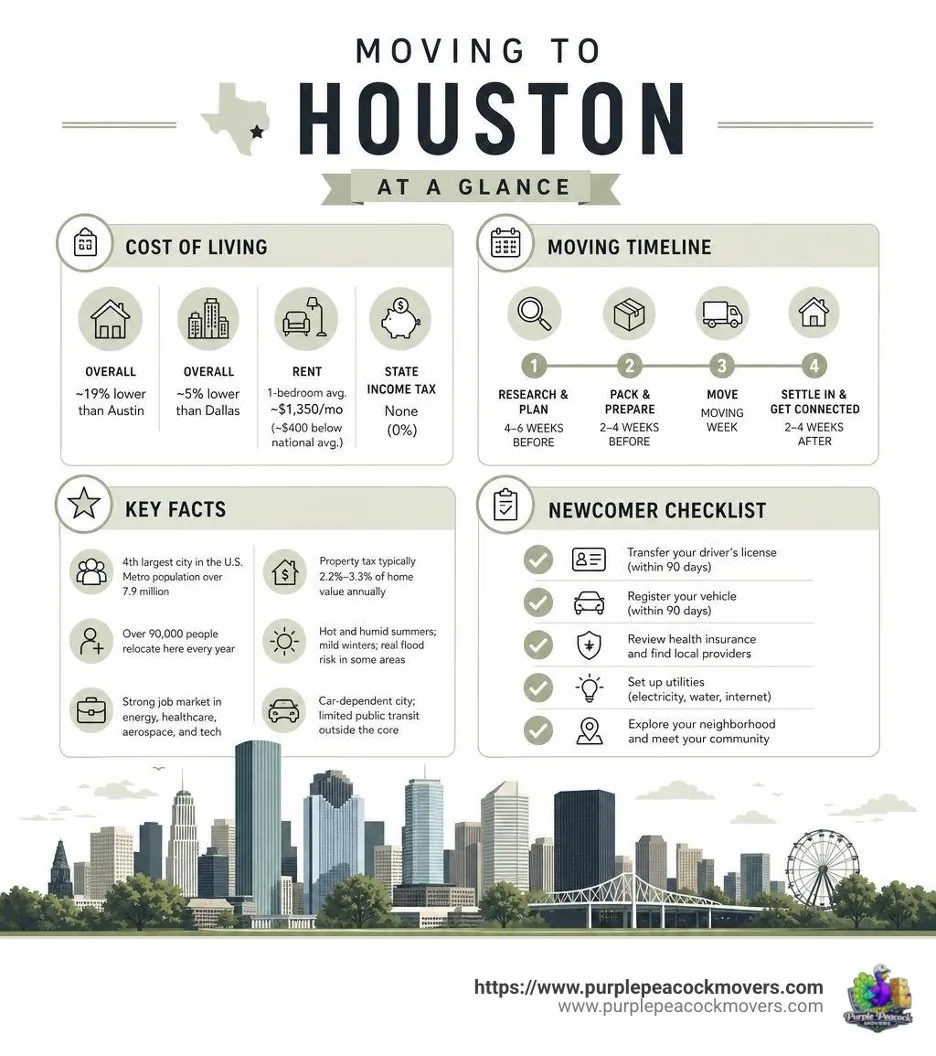
Here's a quick overview of what to expect:
Houston is a big deal. More than 90,000 newcomers arrive every year — and they're not coming for the humidity.
They're coming because you can build a comfortable life here without spending everything you earn on housing. A salary of $100,000 in Austin stretches as far as about $130,000 in Houston. That gap is hard to ignore.
But Houston also comes with real trade-offs. The summer heat is brutal. Flood risk is location-specific but serious. Property taxes are among the highest in the country. And if you don't understand the city's deregulated electricity market before moving, you could be in for an expensive surprise.
This guide covers all of it — the financial math, the best neighborhoods, the climate realities, the legal deadlines, and the mistakes that trip up most newcomers.
The Financial Reality of Moving to Houston in 2026
When you begin researching the financial side of Moving to Houston, the numbers look appealing. But you have to look at the complete balance sheet to understand what you will pay.
Let's start with the good news: housing affordability. While coastal cities and even other Texas hotspots have seen housing prices skyrocket, Houston has remained grounded. The median home price in Houston sits at around $261,730, which is refreshing compared to Austin's median of approximately $500,000.
If you plan to rent when you first arrive, a one-bedroom apartment in Houston rents for an average of $1,350 per month. That is roughly $400 less than the national average, allowing you to keep more money in your pocket as you settle in.
To put this in perspective, let's look at how Houston compares to its closest Texas neighbors:
As detailed in Moving to Houston in 2026: The Complete Relocation Guide - HAR.com, someone earning $100,000 in Austin only needs about $77,000 to maintain the exact same standard of living in Houston.
The Texas Tax Trade-Off: Income vs. Property Taxes
Texas has no state income tax, which is a massive draw for out-of-state movers. If you are a W-2 earner making $200,000 and relocating from California or New York, you can expect to save roughly $15,000 to $20,000 every single year in state income taxes alone.
However, the state has to fund its schools, roads, and emergency services somehow. It does this through property taxes. Property taxes in the Houston area commonly range from 2.2% to 3.3% of the home's assessed value. On a $400,000 home, you could easily pay between $8,800 and $13,200 annually in property taxes.
The good news? You aren't completely powerless against these high rates. Approximately 60% to 70% of property tax protests filed in Harris County result in a reduction of the home's appraised value, which directly lowers your tax bill. Many residents hire professional consultants to handle this protest annually, or they do it themselves online before the May 15 deadline.
For a detailed breakdown of how to prepare your budget for these unique Texas tax structures, you can check out the Moving to Houston Relocation Guide | Eddie Weir REALTOR® .
Job Market and Strongest Industries
A major reason why so many people are Moving to Houston is the sheer strength and diversity of the local job market. While historically known as the "Energy Capital of the World," Houston's modern economy is built on several massive pillars.
The average salary in Houston is $71,662 as of December 2025. The job market is anchored by several key industries:
- Healthcare and Life Sciences: The world-renowned Texas Medical Center (TMC) is the largest medical complex on earth. Spanning 2.1 square miles, it employs over 120,000 health professionals across dozens of hospitals, research institutions, and medical schools.
- Energy and Climate Tech: While traditional oil and gas giants still dominate massive corporate campuses along the Energy Corridor, Houston is rapidly becoming a hub for the global energy transition, attracting billions in green energy and climate tech investments.
- Aerospace: NASA's Johnson Space Center has made Houston a legendary name in space exploration. The aerospace sector continues to grow rapidly, fueled by both federal contracts and private aerospace companies expanding their local footprints.
- Logistics and Advanced Manufacturing: Thanks to the Port of Houston—one of the busiest ports in the world—and a massive network of railways and highways, logistics and manufacturing are major employment drivers.
Whether you are relocating for a corporate transfer or looking to break into a new field, the city's economic diversity offers incredible stability.
Navigating Houston's Neighborhoods and Suburbs
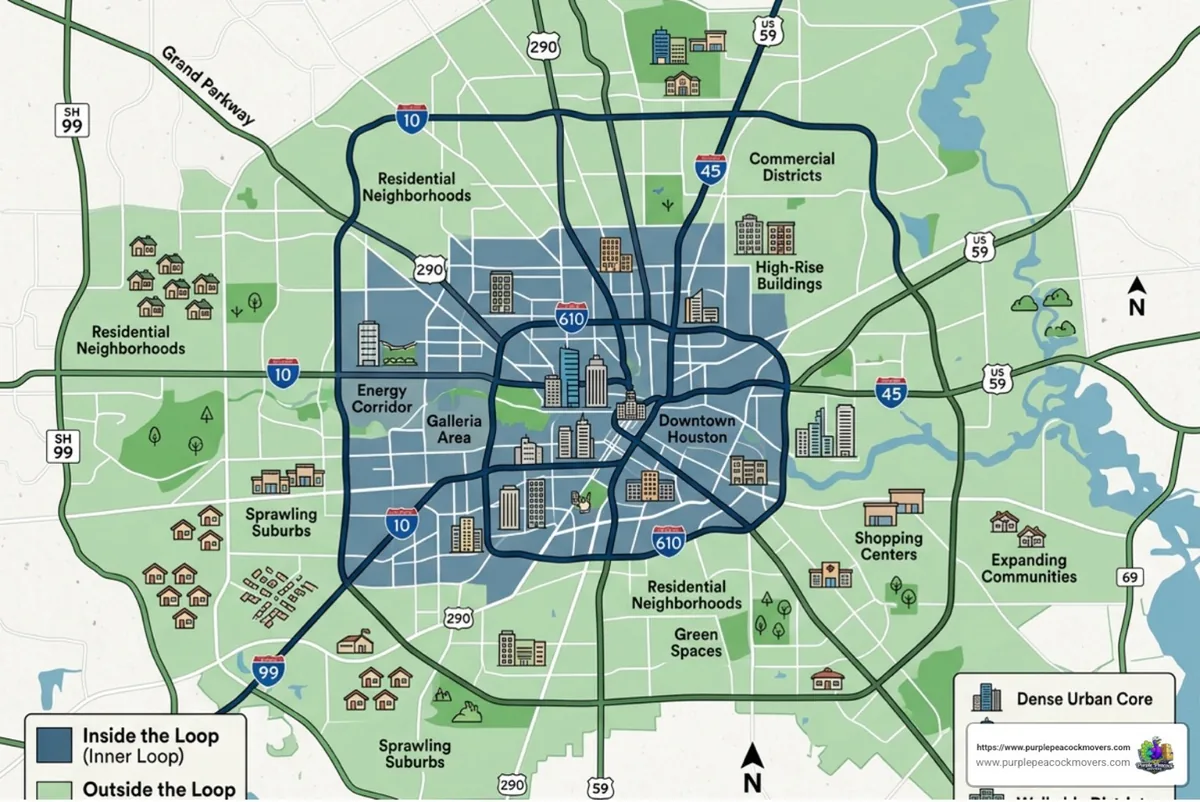
To understand Houston's geography, you must first understand "The Loop." Interstate 610 forms a circular highway around the center of the city.
Inside the Loop (Inner Loop): This is the historic, dense, and highly walkable core of Houston. It is home to trendy restaurants, historic bungalows, high-rise apartments, and cultural centers. Living here means shorter commutes to downtown but higher housing costs and smaller yards.
Outside the Loop (Outer Loop) & Suburbs: This is where you will find expansive master-planned communities, top-tier suburban school districts, and massive backyards. This area is bisected by the Grand Parkway (Highway 99), a massive outer ring road that has completely transformed suburban travel by making it easy to zip between outer communities without driving all the way into the city center.
Because the Houston metro area covers over 10,000 square miles—making it larger than the entire state of New Jersey—your choice of neighborhood will dictate your daily commute, your lifestyle, and your budget.
Best Neighborhoods for Families Moving to Houston
If you are relocating with school-aged children, your search will likely focus on the highly-rated Independent School Districts (ISDs) located in Houston's suburbs. Here are the top family-friendly areas to consider:
Katy, Texas
Katy is widely considered the gold standard for suburban family living in the Houston area. Known for its master-planned communities like Cinco Ranch and Cane Island, the area features resort-style pools, miles of paved hiking trails, and neighborhood lakes. The Katy Independent School District is consistently ranked among the best in the state.
If you are planning a move to this thriving suburban hub, we specialize in helping families transition smoothly to the Katy, Texas Area (and we also serve the Katy, Texas (Alt) Area to ensure full coverage of this massive community).
The Woodlands
Located about 30 miles north of downtown, The Woodlands is a heavily forested, master-planned wonderland. It functions almost like a self-contained resort town, featuring top-tier public schools, luxury shopping, and outdoor concert venues. If you want to live in a highly polished, tree-filled bubble where you rarely have to leave the neighborhood, check out our dedicated services for The Woodlands Area.
Sugar Land
True to its sweet name, Sugar Land is an exceptionally clean, safe, and diverse community southwest of Houston. It offers highly-rated schools, beautiful master-planned neighborhoods, and a bustling town square. Learn more about how we help families settle into the Sugar Land Area.
Cypress & Fulshear
For families wanting a bit more space, Cypress offers fantastic master-planned communities like Bridgeland and Towne Lake, which feature massive recreational lakes. We regularly assist families moving to the Cypress, Texas Area.
If you want a "rural-chic" vibe with larger acreage lots that still offer modern luxury, Fulshear is the fastest-growing hotspot in the region. You can explore our local moving services for the Fulshear Area, as well as nearby growing communities like the Richmond Area and the Tomball Area.
Top Areas for Young Professionals and Culture
If you prefer walkability, historic architecture, and being steps away from some of the best food in the country, you will want to look Inside the Loop. Here are the top urban neighborhoods:
- Montrose: Often called the artistic heart of Houston, Montrose is an eclectic, bohemian neighborhood filled with 1920s bungalows, indie coffee shops, art galleries, and incredible nightlife. It is highly walkable and incredibly welcoming.
- Houston Heights (The Heights): This historic neighborhood features beautiful Victorian-style homes, tree-lined streets, and a quirky, independent business district along 19th Street. It offers a tight-knit community feel right in the middle of the city.
- Midtown: Located south of downtown, Midtown is a high-energy neighborhood dominated by mid-rise apartments, trendy bars, and diverse eateries. It is popular with young professionals who want to commute to downtown via the METRORail.
- Museum District: Perfect for culture lovers, this beautiful neighborhood is home to 19 world-class museums, the sprawling Hermann Park, and the Houston Zoo.
If you are looking to make your home in the vibrant, historic heart of the city, we have years of experience navigating the tight streets and historic properties of the Central Houston Area.
Surviving the Climate, Floods, and the Grid

Let's address the elephant in the room: Houston's weather.
From late June through September, the heat and humidity are intense. Locals often joke that "you don't just feel the air; you wear it." Temperatures regularly reach the mid-to-high 90s, and the humidity can make it feel like 105°F or higher.
However, you learn to adapt. You run your errands in the early morning, enjoy the incredible central air conditioning found in every building, and spend your summers in the pool. The reward is eight months of absolutely gorgeous weather from October through May, with mild winters where highs regularly sit in the comfortable 60s and 70s.
The Critical Reality of Houston Flooding
Because Houston is flat and bisected by a massive network of bayous, flooding is a serious, localized risk. It is a common misconception that the entire city floods. In reality, flood risk is incredibly hyper-local—one street might flood during a major storm while the adjacent street stays completely dry.
FEMA's updated flood maps expanded the city's 100-year floodplain by 43%, growing it from 150,000 to approximately 200,000 acres. This reclassified over 170,000 properties into high-risk Flood Zone AE.
Zone AE (High Risk): Properties in this zone have a 1% annual chance of flooding. If you have a federally-backed mortgage, you will be required to carry flood insurance, which can add $800 to $2,400+ per year to your housing costs.
Zone X (Moderate to Low Risk): Properties outside the 100-year floodplain. While flood insurance isn't legally required here, we highly recommend purchasing it anyway. Approximately 25% to 30% of all flood claims in Houston come from properties located in Zone X.
Before buying or renting a home, always look up the exact address on the Harris County Flood Control District website and check the property's specific flood history.
Navigating the Logistics of Moving to Houston
The physical act of moving is only half the battle. To successfully transition to Texas, you need to understand the state-specific administrative processes and deadlines.
To help you stay on track, we recommend utilizing a structured timeline like the Moving to Houston Checklist: 60-90 Day Plan | Eddie Weir or reviewing the steps in the Moving to Houston Checklist 2026: 90-Day Step-by-Step Plan.
1. Navigating the Deregulated Electricity Market
Unlike most states where you receive power from a single local utility company, Texas has a deregulated electricity market. This means you must actively shop for and select your own Retail Electric Provider (REP).
The physical delivery of your electricity is still handled by a single local utility (in Houston, this is CenterPoint Energy), which charges a set baseline delivery fee. However, the rate you pay for the actual electricity is determined by the REP you choose.
When setting up your utilities, go to the official state comparison portal, PowerToChoose.org.
Avoid the Traps: Be highly skeptical of "Free Nights and Weekends" plans or variable-rate plans. These plans often feature incredibly high rates during the daytime when you are actually using power. If you are working from home, these plans can result in massive bills.
Choose Fixed Rates: Always select a 12-month fixed-rate plan. This locks in your rate per kilowatt-hour (kWh) and protects you from price spikes during extreme summer heat or winter freezes.
2. Driver's License and Vehicle Registration
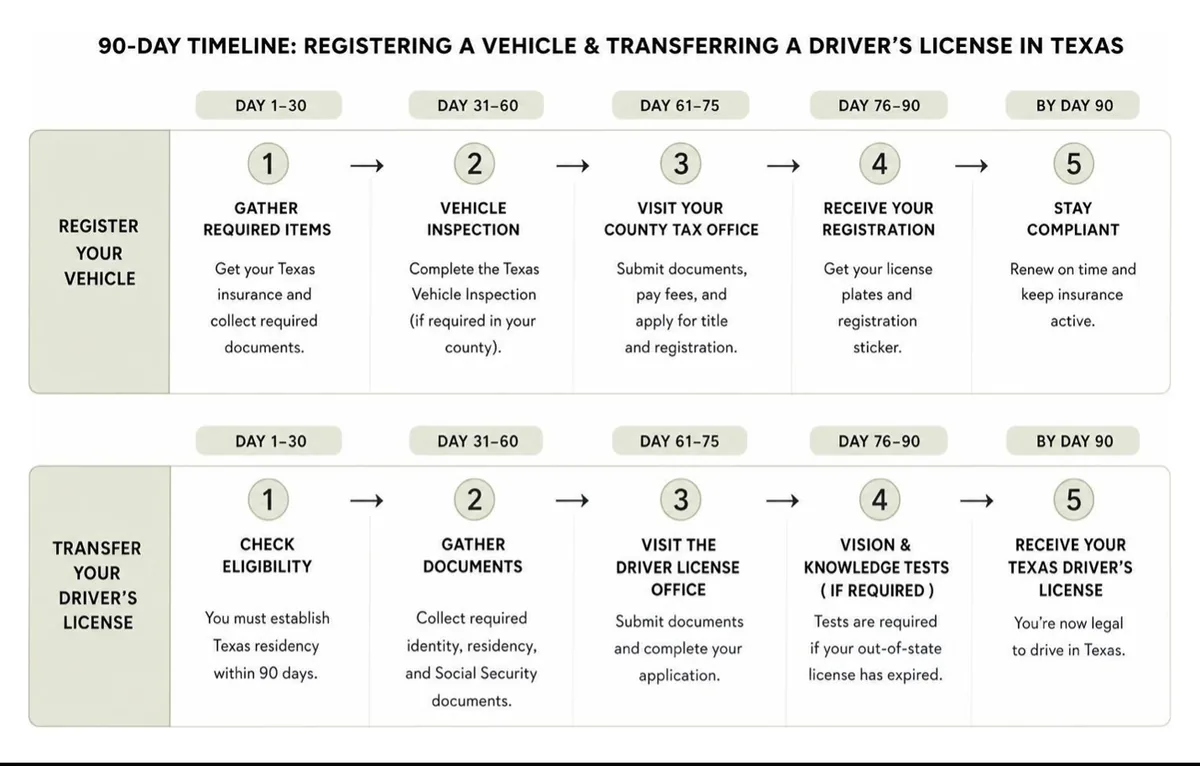
Texas law gives new residents a strict 90-day window to transfer their driver's license and register their vehicles. The state-specific order of operations is highly specific:
- Get Texas Auto Insurance: You cannot register your car or get a license without proof of a Texas auto insurance policy. Ensure your policy meets or exceeds the state minimum liability limits (30/60/25).
- Get a Vehicle Inspection: Take your vehicle to a certified Texas State Inspection station. While Texas eliminated safety inspections for passenger cars in 2025, emissions testing is still mandatory in Harris County and surrounding areas. The inspection typically costs around $25.
- Register Your Vehicle: Visit your local County Tax Assessor-Collector's office. You must bring your vehicle inspection report, proof of Texas insurance, the out-of-state title, and payment for registration fees (typically $250 to $400 per vehicle depending on the vehicle's weight and value).
- Transfer Your Driver's License: Once your car is registered, schedule an appointment online with the Texas Department of Public Safety (DPS). Appointments can book out weeks in advance, so schedule this early. Bring your proof of identity, social security card, two documents proving Texas residency (like a utility bill or lease agreement), and your vehicle registration receipt.
3. The Texas Homestead Exemption
If you purchase a home in Houston, this is the single most important tax-saving step you can take. The Texas Homestead Exemption removes a portion of your home's value from taxation, which can save you thousands of dollars annually. Even better, it places a "cap" on your property taxes, preventing your home's appraised value from increasing by more than 10% per year.
When to File: You can file for your homestead exemption online with your county appraisal district as soon as you receive your new Texas driver's license showing your new home address.
The Deadline: The absolute deadline to file is April 30 of the year following your purchase. Missing this deadline can cost a typical homeowner $1,500 to $3,500 in avoidable taxes in the first year alone.
For a broader look at the moving process and local market conditions, you can also consult Relocating to Houston in 2026: Your Success Guide | Bexley Realty Group or the comprehensive Moving to Houston TX: 2026 Relocation Guide .
Frequently Asked Questions About Moving to Houston
Is Houston cheaper than Austin or Dallas?
Yes, Houston is significantly more affordable than both Austin and Dallas. The overall cost of living in Houston is about 19% lower than in Austin and roughly 5% lower than in Dallas.
The primary driver of this savings is housing. While the median home price in Austin is around $500,000, Houston's median home price sits at an incredibly accessible $261,730. This affordability extends to the rental market, where a standard one-bedroom apartment in Houston rents for around $1,350 per month, compared to over $1,750 in Austin.
Do I need a car to live in Houston?
Yes, a car is highly necessary for almost everyone living in Houston. The city has a very low Walk Score of 47 and a Transit Score of only 36.
While the METRORail light rail system is highly efficient, its coverage is limited to about 23 miles, primarily connecting Downtown, Midtown, the Museum District, and the Texas Medical Center. If you live or work outside of this central corridor, you will rely on Houston's massive highway system to get around.
EZ TAG: We highly recommend getting an EZ TAG from the Harris County Toll Road Authority (HCTRA). This electronic transponder allows you to use the city's extensive toll road network, saving you significant commute time and avoiding the much higher mail-billed rates.
Insurance Costs: Be prepared for higher auto insurance premiums. Due to highway density, long commute distances, and a local uninsured motorist rate of 14% to 18%, average auto insurance premiums in Houston range from $2,800 to $3,400 per year. We strongly suggest adding Uninsured/Underinsured Motorist (UM/UIM) coverage to your policy.
What is a MUD tax in Houston?
A Municipal Utility District (MUD) tax is a special property tax levied on homes located in newer suburban developments, particularly outside the city limits.
Because these neighborhoods were built on land that lacked city-provided water, sewer, and drainage infrastructure, a MUD was created to issue bonds to fund the construction of these utilities. The homeowners in that district pay a MUD tax to pay off those bonds over time.
A MUD tax appears as a separate line item on your annual property tax bill and can add anywhere from 0.30% to 1.50% to your effective tax rate. When budgeting for a home in the suburbs, always ask about the specific MUD tax rate, as it can add up to $4,500 annually to your housing costs on a $300,000 home.
Conclusion
Moving to Houston is an incredible opportunity to advance your career, enjoy world-class culture, and secure a spacious home without stretching your finances to the limit. While the summer heat, complex utility markets, and hyper-local flood risks require careful planning, millions of residents agree that the benefits of living in the Bayou City far outweigh the challenges.
At Purple Peacock Movers, we are dedicated to making your transition to Houston completely stress-free. Whether you are moving into a historic bungalow in Montrose or a spacious family home in Katy, our professional team handles the heavy lifting so you can focus on settling into your new Texas lifestyle.
Ready to make your move? Contact us today to learn more about our Local Moving Services and get a free, personalized quote for your relocation. We also offer comprehensive Long Distance Moving Services and professional Packing Services to handle every detail of your journey. Let's get you moved to Houston—without melting!